
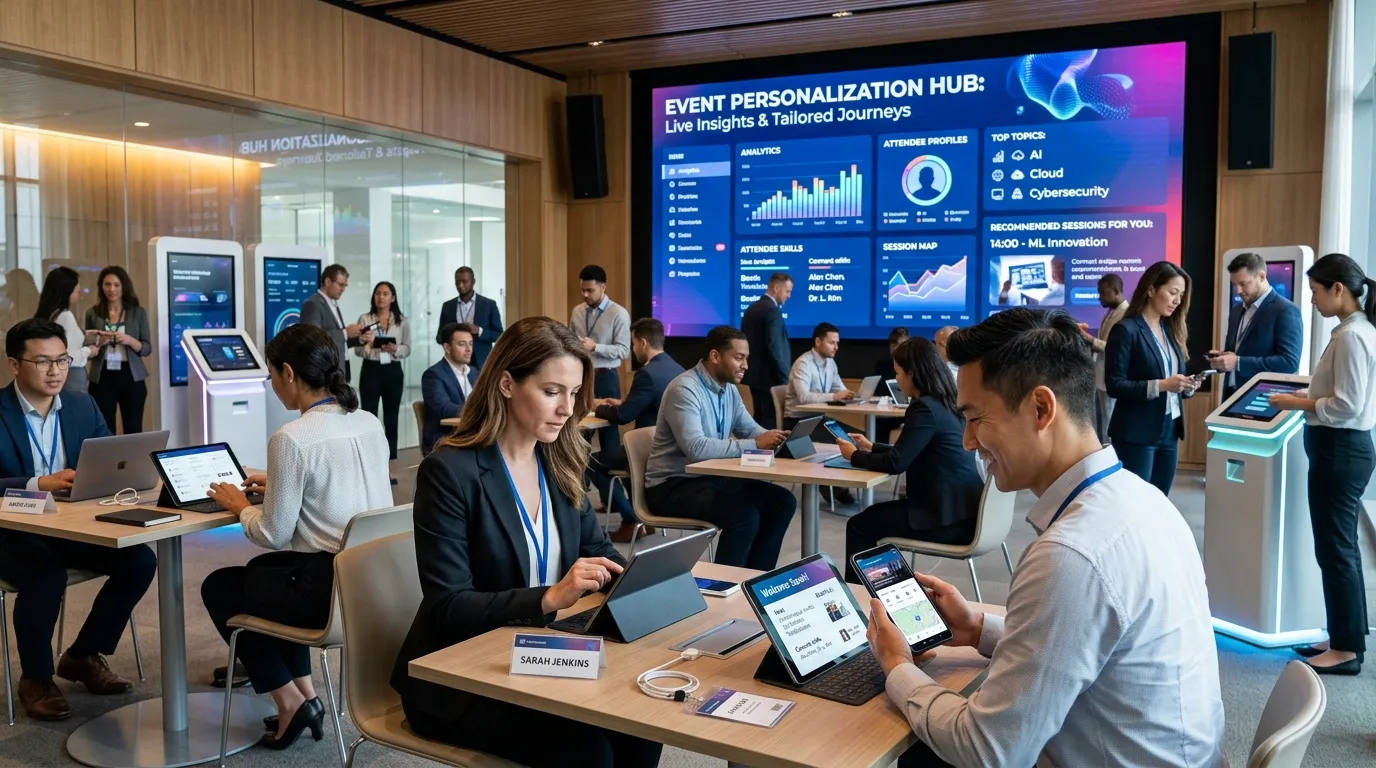
Attendee expectations have changed for good. People no longer want to sift through irrelevant sessions or wade through one-size-fits-all agendas. They want events that feel built for them—sessions matched to their goals, networking introductions that make sense, and communication that respects their time. Event personalization technology makes that possible at scale.
This guide explains what event personalization technology is, how it works, and why it has become essential rather than optional. You’ll learn the benefits for both attendees and organizers, see real applications across the full event journey, and understand how AI event personalization is reshaping the industry. We’ll also cover best practices for rolling it out, the challenges to plan for, and the trends shaping what comes next.
Whether you run a 50-person workshop or a 50,000-attendee conference, these insights will help you create personalized event experiences people remember—and results you can prove.
What is event personalization technology?
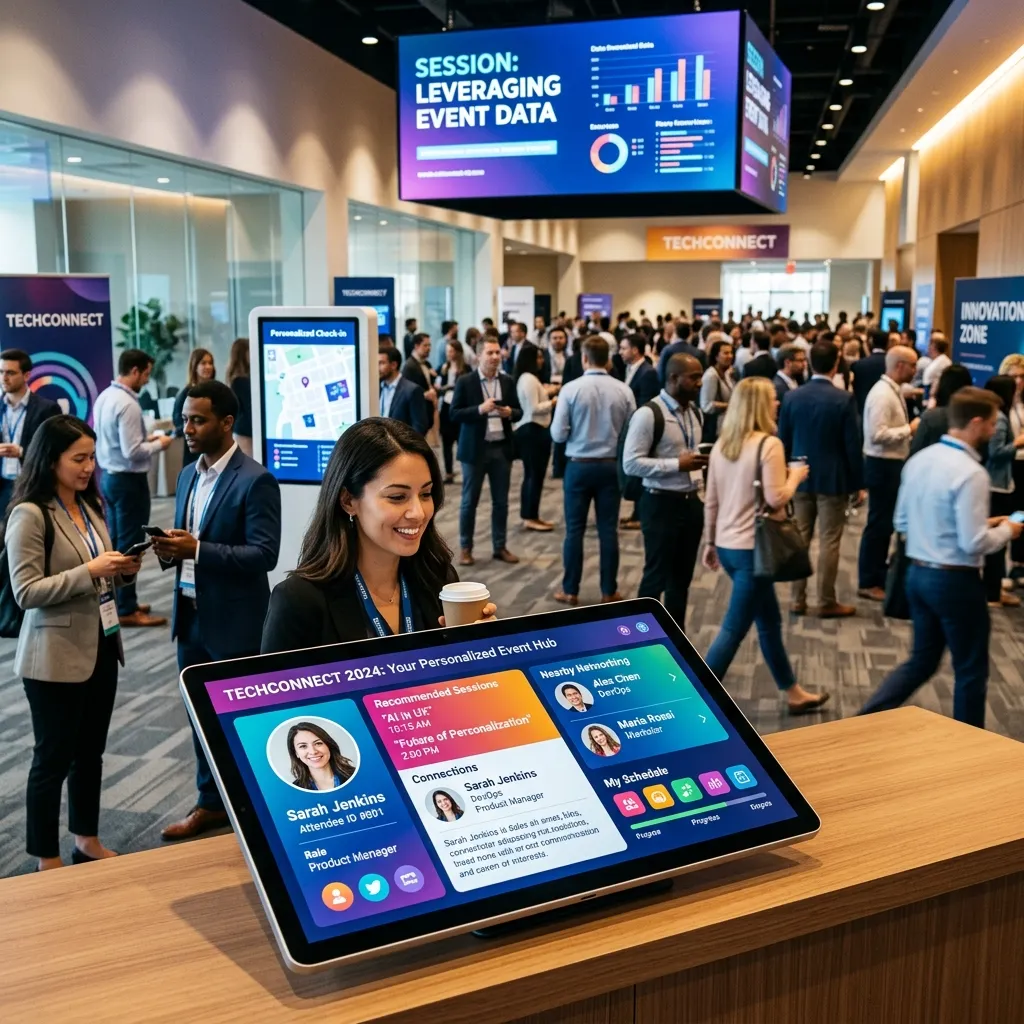 Event personalization technology is a category of event technology solutions that uses data, artificial intelligence, and automation to tailor an event to each individual attendee. Instead of delivering the same agenda, emails, and recommendations to everyone, it adapts content, networking suggestions, and communication based on who each person is and how they behave.
The shift it represents is fundamental. Events have moved from broadcasting to crowds toward designing journeys for individuals. The events that win attention and earn repeat attendance are built around people, not the program.
What are the key components of event personalization platforms?
Effective event personalization technology rests on three core components working together:
- Data collection and analytics: The engine of personalization. Platforms gather demographic data (job role, industry, location), behavioral data (sessions viewed, booths visited, emails opened), and stated preferences from registration and surveys. Without this data, personalization is just guesswork.
- AI and machine learning algorithms: These analyze attendee behavior to recommend sessions, suggest networking matches, and surface relevant content automatically. Machine learning sharpens its recommendations over time, so each event performs better than the last.
- Integration capabilities: The best platforms connect with your existing event tech—CRM, marketing automation, and ticketing systems—so attendee data flows seamlessly between tools rather than sitting in silos.
Why has personalization shifted from a nice extra to a core requirement?
Relevance drives action. An attendee who receives session recommendations tied to their job role is far more likely to show up, participate, and leave satisfied than one handed a generic schedule. As attendee expectations rise, personalized event experiences have become the baseline people expect rather than a pleasant surprise.
What are the benefits of event personalization technology?
The returns run in two directions—attendees get relevance, organizers get results.
How does event personalization technology benefit attendees?
For attendees, the payoff is a curated journey that feels effortless:
- Enhanced engagement and satisfaction: When an event speaks to someone’s specific needs, they engage more deeply and stay longer.
- Relevant content and recommendations: Tailored “recommended for you” session lists save time and surface sessions people would otherwise miss.
- Improved networking opportunities: AI-powered matchmaking introduces attendees to people genuinely worth meeting, reducing first-day awkwardness.
- Seamless user experience: From a registration form that adapts to their answers to wayfinding that knows where they want to go, every touchpoint feels handpicked.
How does event personalization technology benefit organizers?
For organizers, personalized event experiences deliver measurable advantages:
- Increased attendance and retention: People return to experiences that felt built for them. Repeat attendance is the clearest signal personalization is working.
- Higher ROI and revenue: Personalized communication cuts through inbox clutter—messages referencing an attendee’s interests get opened, while generic blasts get ignored.
- Data-driven insights: Every personalized event generates rich first-party data that fuels smarter decisions for future events.
- Streamlined operations: Automation handles the heavy lifting of tailoring experiences at scale, freeing your team to focus on strategy.
- Competitive advantage: In a crowded market, the events designed around individuals stand out from the ones designed around agendas.
What are the key applications of personalized event experiences?
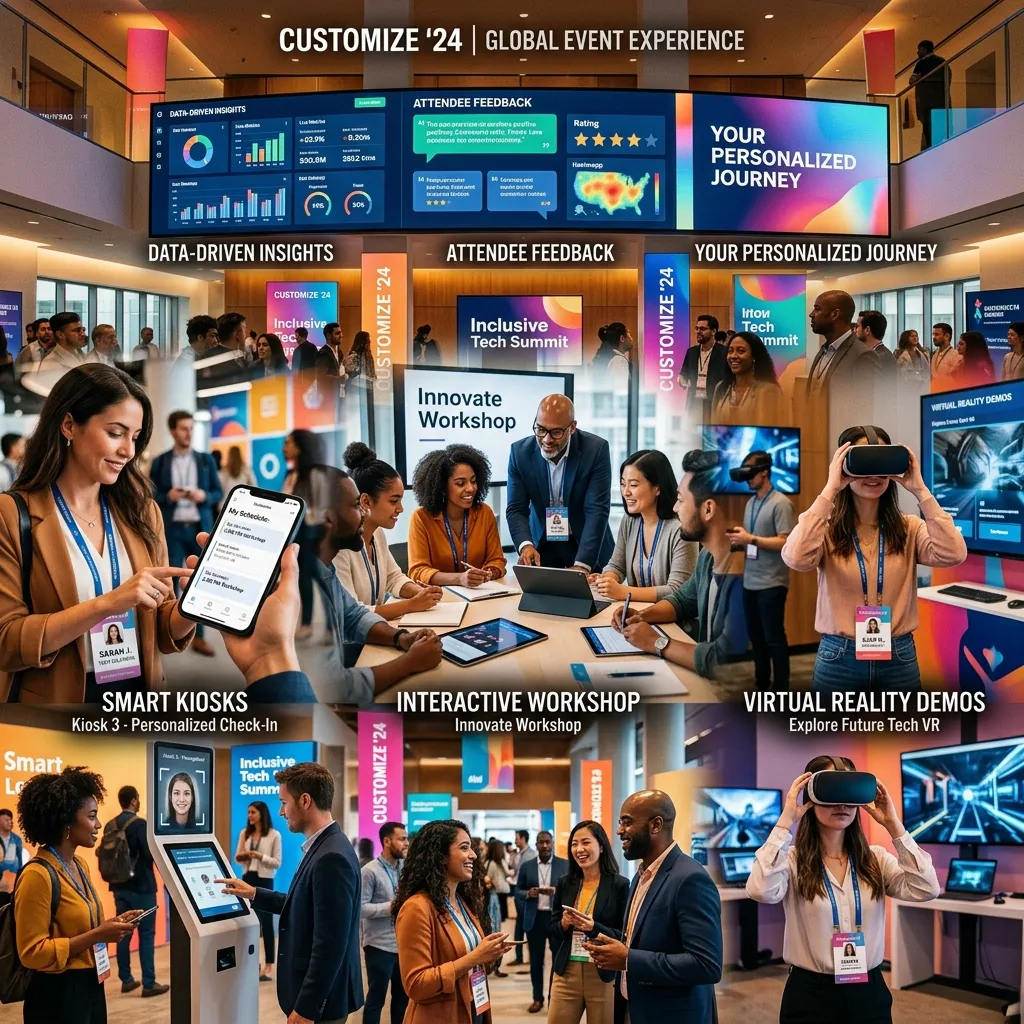 Personalization isn’t a single feature—it’s a thread that runs through the entire event journey. Here’s how event technology solutions apply it from first invitation to final follow-up.
What does pre-event personalization look like?
What happens before the doors open sets the tone for everything after:
- Personalized invitations and registration flows: Smart registration forms adapt based on responses, asking about goals and session preferences upfront.
- Tailored content recommendations: Welcome emails suggest sessions based on stated interests, while digital welcome kits differ for first-timers and returning guests.
- Customized scheduling and agenda building: Attendees get a personalized schedule shaped around their goals before they ever arrive.
As research on how users interact with event ticketing platforms shows, reducing friction from the very first interaction shapes how attendees feel before they walk in.
What does during-event personalization look like?
The live experience is where personalization proves its worth:
- AI-powered matchmaking for networking: The platform recommends who each attendee should meet based on interests and goals.
- Real-time content recommendations: Suggestions for sessions starting soon or exhibitors worth visiting, delivered at the right moment.
- Personalized notifications and alerts: Timely nudges tailored to each attendee’s schedule and interests.
- Interactive maps and wayfinding: Event apps guide attendees to their next session or networking match with directions based on where they are.
What does post-event personalization look like?
The event isn’t over when the lights go down:
- Customized follow-up communications: Someone who attended three marketing sessions receives marketing-focused follow-ups, not a generic content dump.
- Personalized feedback surveys: Questions tailored to the sessions each person actually attended get higher response rates and better insights.
- Curated content libraries: Session recordings, slides, and resources matched to each attendee’s journey.
- Recommendations for future events: Behavioral and interest data suggests upcoming events each person will genuinely care about.
This deeper dive into personalized event experiences breaks down how relevance drives engagement at every single stage.
How is AI event personalization transforming the industry?
Artificial intelligence is the engine behind modern event personalization technology. It delivers a level of hyper-personalization that would be impossible to manage by hand.
How does AI deliver hyper-personalization?
AI and machine learning analyze attendee behavior in real time to recommend relevant sessions, suggest high-value networking matches, and surface content tailored to individual interests. According to industry analysis from EventMB, AI-powered recommendations make large events feel personal, which directly increases participation.
What role does predictive analytics play?
Predictive analytics uses historical and behavioral data to anticipate what attendees want before they ask. Platforms can forecast which sessions will fill up, predict networking interest, and even flag attendees at risk of disengaging—giving organizers time to act.
How does NLP support sentiment analysis?
Natural Language Processing (NLP) reads through survey responses, chat messages, and social media mentions to gauge how attendees feel. This turns thousands of unstructured comments into clear sentiment signals organizers can act on quickly.
How does machine learning keep optimizing personalization?
Machine learning improves with every event. The more data it processes, the sharper its recommendations become—turning each event into a smarter, more tailored experience than the one before. According to research published by Harvard Business Review, data-driven personalization consistently outperforms generic approaches.
How do you implement event personalization technology? Best practices
 Rolling out event technology solutions works best as a deliberate process rather than a guess.
- Define clear personalization goals. Decide what you want personalization to achieve—higher session attendance, more networking connections, better retention—before choosing tools.
- Choose the right event technology solutions. Look for built-in personalization features: customizable agendas, recommendation engines, AI-powered matchmaking, and adaptive content feeds. A platform with these baked in saves enormous manual effort.
- Address data privacy and ethics. Be transparent about what you collect and why, get clear consent, and comply with regulations like GDPR and CCPA. Personalization should feel helpful, never invasive.
- Integrate with existing systems. Connect your CRM and marketing automation so registration data informs email campaigns and behavioral data triggers personalized follow-ups.
- Test and optimize iteratively. Launch, measure, refine, and repeat. The strongest programs treat personalization as a continuous process, not a one-time setup.
The smooth, user-centric design that powers great personalization starts at the booking stage too. As covered in this guide on how UX design affects event bookings, reducing friction early protects the experience all the way through.
What are the challenges and future trends in event personalization?
What challenges should you plan for?
Event personalization technology brings real challenges worth taking seriously:
- Data silos and integration complexities: Personalization lives or dies on connected data. Scattered systems that don’t talk to each other undermine the whole effort.
- Cost of implementation: Personalization takes time, tools, and budget. Start small with high-impact tactics, prove the value, then scale.
- User adoption and privacy concerns: There’s a fine line between helpful and “creepy.” Recommending a session based on stated interests feels useful; referencing data an attendee didn’t knowingly share feels unsettling.
What future trends will shape event personalization?
The technology is evolving fast, and several trends are already taking shape:
- Hyper-realistic virtual and hybrid experiences: Virtual and augmented reality promise immersive events where remote attendees feel as engaged as in-person ones.
- Increased use of wearable technology: Wearables will feed real-time behavioral data into personalization engines, enabling even more responsive experiences.
- Advanced AI and predictive modeling: Sharper algorithms will anticipate attendee needs with growing accuracy.
- Greater emphasis on ethical AI and transparency: As personalization deepens, clear consent and responsible data use will become competitive differentiators, not just compliance boxes.
Understanding how these tools influence event attendance behavior will help organizers stay ahead as expectations keep rising.
Building events people remember
 Event personalization technology comes down to one principle: design every touchpoint around the individual. From a registration form that adapts to each answer, to a custom agenda, to a follow-up email that references exactly what someone attended, each personalized moment deepens the connection between attendee and event.
The components work together as a system—data collection feeds AI algorithms, algorithms power recommendations, and integration ties it all to your existing tools. None stands alone, and the organizers who treat personalization as a continuous process will pull ahead of those who treat it as a one-time project.
Looking forward, AI event personalization will only grow more powerful. What feels cutting-edge today will soon be the baseline attendees expect. The organizers who start now—experimenting, measuring, and refining—will build the loyal audiences of tomorrow.
Start small. Pick two or three personalization strategies, apply them to your next event, measure the results, and expand from there. Your attendees will notice the difference, and your engagement and ROI will show it.
Conclusion
Event personalization technology is transforming how organizers connect with attendees by delivering more relevant, engaging, and memorable experiences. Through data-driven insights, automation, and AI event personalization, events can offer tailored content, networking opportunities, and recommendations that match individual interests. These personalized event experiences not only improve attendee satisfaction but also increase participation, retention, and overall event performance. As technology continues to evolve, organizations that embrace personalization will be better positioned to create meaningful connections and stand out in an increasingly competitive event industry.
Frequently Asked Questions
1. What is event personalization technology?
Event personalization technology is software that uses data, AI, and machine learning to tailor an event to each individual attendee. It adapts content, networking recommendations, scheduling, and communication based on who someone is and how they behave, turning generic events into personalized event experiences.
2. How does event personalization technology work?
Event personalization technology works by collecting attendee data, analyzing it with AI and machine learning algorithms, and using the insights to deliver tailored recommendations. It integrates with your CRM, ticketing, and marketing tools so data flows seamlessly and personalization happens automatically at scale.
3. What are the benefits of event personalization technology?
For attendees, the benefits include relevant content, better networking, and a seamless experience. For organizers, event personalization technology drives higher attendance, stronger retention, better ROI, richer data, and a competitive edge in a crowded market.
4. How does AI event personalization improve events?
AI event personalization analyzes attendee behavior to recommend relevant sessions, suggest high-value networking matches, and surface tailored content automatically. Machine learning refines these recommendations over time, making each event more personal and increasing participation at scale.
5. What data do you need for event personalization?
Effective event personalization uses demographic data (job role, industry, location), behavioral data (sessions viewed, booths visited, emails opened), and stated preferences from registration or surveys. Always collect this data transparently and with clear consent.
6. What event technology solutions support personalization?
Look for event technology solutions with built-in personalization features: customizable agendas, recommendation engines, AI-powered matchmaking, adaptive content feeds, and integration with CRM and marketing automation tools. These enable personalization without overwhelming your team.
7. Is event personalization technology expensive to implement?
Costs vary based on platform features, event size, and complexity. The smart approach is to start small with high-impact tactics, prove the value, then scale. As the technology matures, it continues to become more affordable and accessible.
8. How do you personalize events without being intrusive?
Personalize without being intrusive by staying transparent about what data you collect and why, getting clear consent, and only using information attendees knowingly shared. Helpful recommendations feel good, while using hidden data feels unsettling.
9. How do you measure the success of personalized events?
Measure success by tracking engagement rates (session attendance, polls, app activity), satisfaction scores (NPS and surveys), conversion rates (actions on recommendations and future registrations), and retention through repeat attendance. Pair these metrics with qualitative feedback.
10. Who benefits most from event personalization technology?
Both attendees and organizers benefit. Attendees enjoy more relevant, satisfying, and memorable personalized event experiences, while organizers gain higher engagement, stronger loyalty, richer data, and improved ROI from repeat attendance and word of mouth.
